
First Bend Leaders at Oxford Stadium: How Early Pace Converts to Wins
 Available in US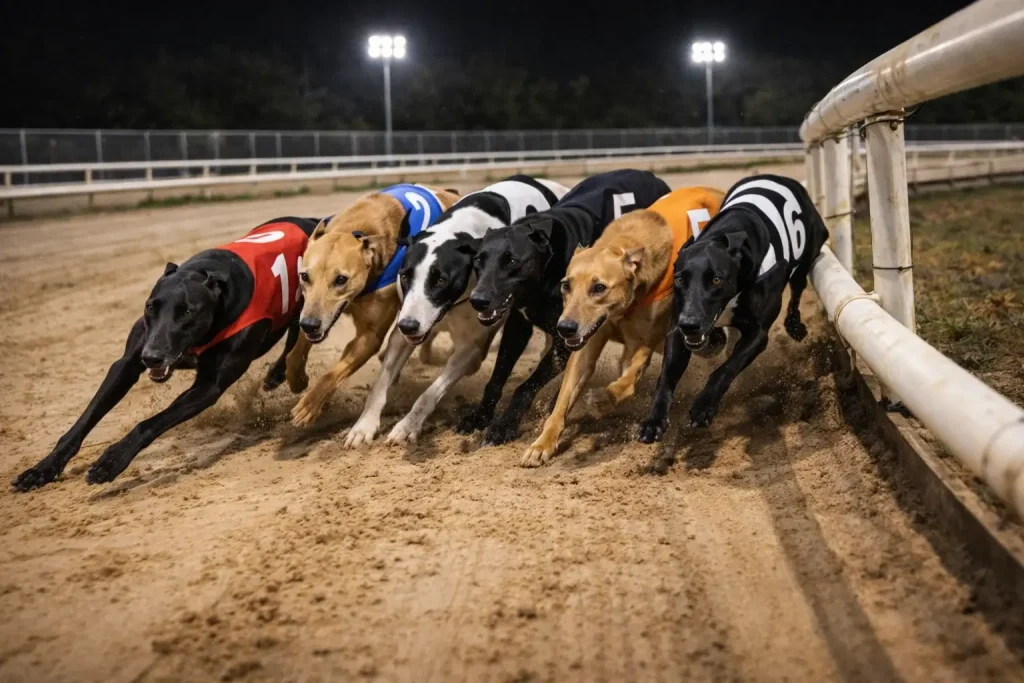
Understanding why first-bend position matters so much at Oxford, and quantifying exactly how often leaders prevail, gives form students a foundational edge. This article examines the data behind first-bend dominance, explores how distance affects the correlation, and explains how to incorporate early pace analysis into practical betting decisions.
The wider context is set out in our Oxford greyhound results guide.
Why First Bend Matters
Greyhound racing compresses six dogs into a tight space around a shared bend. The dog reaching that turn first gains clear running, avoiding the interference that plagues those trailing behind. While followers must navigate traffic, check their stride, and lose momentum to avoid collisions, the leader races unimpeded, maintaining velocity through the turn and into the back straight.
Oxford’s 379-metre circumference creates relatively tight bends that amplify this advantage. Dogs on the outside of the first turn cover extra ground while those squeezed on the rail lose momentum checking their stride. The leader escapes these problems entirely, gaining lengths simply by avoiding the chaos unfolding behind.
Psychological factors compound the positional benefit. Greyhounds who lead early race with confidence, chasing the mechanical hare without distraction from surrounding rivals. Those behind must overcome not just the physical gap but the mental challenge of pursuit mode. Some dogs thrive chasing and find extra reserves when pursuing a target; many others lose intensity when they cannot see the lure clearly ahead without obstruction.
As Dr Simon Gower, GBGB Veterinary Director, has noted: greyhounds love to run and to race. That instinct drives them hardest when leading the pack with unobstructed views of their quarry. The first-bend leader harnesses this natural drive most effectively, racing with the confidence that comes from dictating terms rather than responding to others.
Oxford-Specific Data
Data across UK tracks shows that the greyhound leading at the first bend wins approximately 35% of races. This figure significantly exceeds the 16.6% expected if finishing positions were random. At Oxford, with its tight first turn located just 108 metres from the start, the correlation between early pace and victory holds firmly.
The 35% win rate for first-bend leaders means nearly double the theoretical average. Put another way, a dog reaching the first bend ahead wins more than one in three races. For bettors, this transforms sectional time analysis from theoretical exercise to practical necessity.
Timeform and other data providers track sectional splits precisely, recording times to the first bend for every runner. Their ratings system, which scales from 0 to 140, incorporates these sectional measurements to assess true ability. Comparing these splits across a dog’s recent races reveals consistency or volatility in early pace. A greyhound posting 5.20 second first-bend splits reliably offers different prospects from one fluctuating between 5.10 and 5.40.
Track the first-bend leader in replays when sectional data lacks precision. Visual confirmation of which dog reached the turn first, and how it raced from there, supplements numerical analysis. Some dogs lead narrowly at the bend but run wide, losing advantage. Others lead decisively and rail through the turn, maximising their positional gain. These distinctions matter when assessing future performance.
Oxford’s re-opening in September 2022 means historical data spans a relatively short period compared to tracks operating continuously for decades. However, the patterns emerging since re-opening align with UK-wide trends, confirming that first-bend dynamics at Oxford follow predictable principles.
Distance Variations
The importance of first-bend position varies with race distance. At 250m sprints, early pace dominates almost entirely. The race effectively ends at the first bend; trailing dogs lack the remaining distance to recover. Sprint racing rewards trap speed and first-bend arrival above all other factors.
The standard 450m distance maintains strong first-bend correlation while allowing limited recovery opportunities. Dogs who reach the first bend in second or third can still win if they possess superior pace through the second half of the race. However, the first-bend leader retains significant advantage, converting at rates exceeding random expectation.
Middle distances like 595m and 645m see the first-bend effect persist but diminish slightly. The extended race duration gives closers more time to deploy their finishing speed. First-bend leaders still win more often than chance predicts, but the gap narrows compared to sprint races.
At staying distances of 845m and 1040m, first-bend position matters less than sustainable pace through multiple circuits. A dog leading at the first bend but lacking stamina will fade before the finish. Stayers with moderate early pace but superior endurance frequently overhaul early leaders in the final lap. The tactical dynamics shift toward stamina assessment rather than pure early-pace analysis.
Betting on Early Pace
Incorporate first-bend projections into every race assessment. Review sectional times from recent runs, identifying which dogs consistently reach the bend quickest. Factor trap draw into these projections: inside traps naturally reach the bend sooner, while wide draws add fractions that slower dogs from better draws might overcome. The interplay between raw early pace and trap position determines who leads at the crucial moment.
When the likely first-bend leader also holds form advantages, confidence increases substantially. A dog with proven early pace, favourable draw, and recent winning form combines multiple positive indicators into a compelling selection. Such picks carry higher strike rates than single-factor choices based on any criterion alone, and the compounding effect justifies shorter prices when all elements align.
Watch for trap clashes between early-pace dogs. When two quick beginners draw adjacent traps, interference risks increase significantly. Both dogs might compromise each other’s breaks, fighting for the same racing line rather than finding clear paths. This scenario allows a cleaner-breaking rival from elsewhere to steal first-bend position unexpectedly, creating value opportunities on third or fourth choices who benefit from the anticipated scrimmage.
Use first-bend analysis to identify value against favourites. If the market leader lacks early pace but tops the betting due to other form factors, and a longer-priced rival consistently reaches bends first, the outsider may offer genuine value. Early-pace superiority sometimes outweighs the sectional time advantages or class indicators the market has prioritised, creating mispricings that informed punters exploit before odds adjust.
Track performance patterns by trap. Some dogs consistently reach the first bend from certain draws but struggle from others. A greyhound with electric early pace from Trap 1 might show pedestrian breaks from Trap 5, lacking the angle to cross efficiently. These trap-specific tendencies matter enormously when the same dog appears in different draw positions across meetings. The historical sectional data remains relevant, but must be interpreted through the lens of current trap allocation.
Conclusion
First-bend position at Oxford Stadium predicts race outcomes with quantifiable reliability. The greyhound leading at the turn wins roughly 35% of races, far exceeding random expectation. This pattern holds across most distances, weakening only at marathon trips where stamina overrides early positioning.
Build first-bend analysis into your standard race assessment. Track sectional times, watch replays for visual confirmation, and factor trap draw into early-pace projections. When you identify the probable first-bend leader and that dog also holds form credentials, you have found the type of selection that delivers consistent returns over time.
The splits behind it are in sectional times.
