
How Weather Affects Greyhound Performance at Oxford Stadium
 Available in US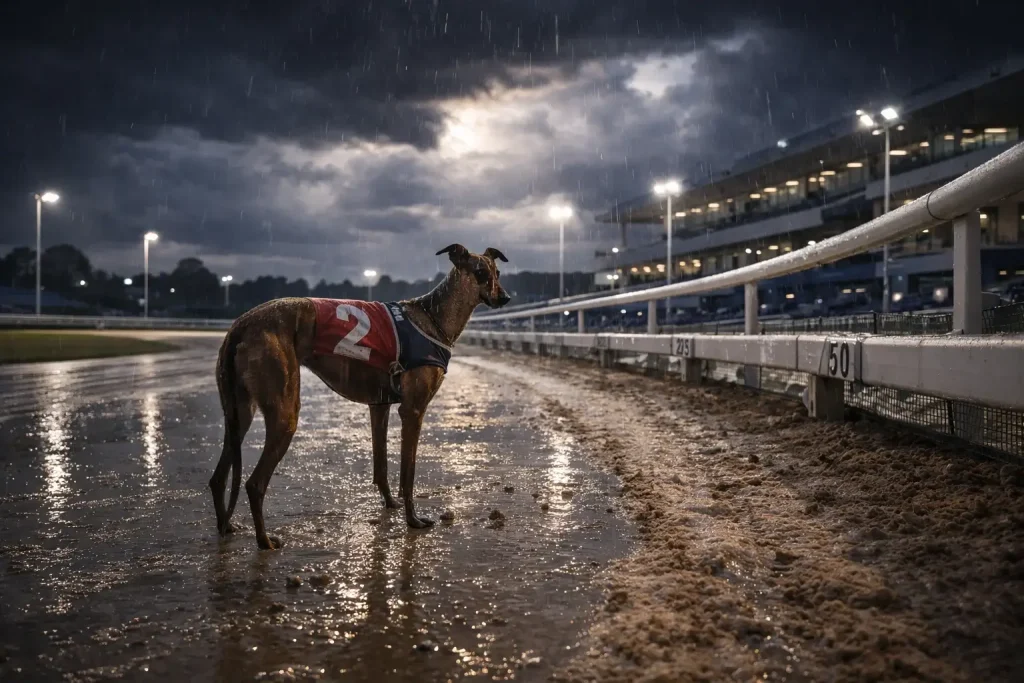
Understanding weather impact at Oxford means moving beyond vague notions that “rain slows dogs down” toward a more granular appreciation of how specific conditions affect specific racing styles. Some greyhounds handle wet tracks better than others. Temperature extremes favour certain physical types. Wind direction can disadvantage particular trap positions. As former trainer Jim Cremin once noted about track variables, “Everything adds up—the surface, the weather, the dog’s condition on the day.” Racing analysis that ignores weather misses a significant piece of the puzzle.
The wider context is set out in our Oxford greyhound results guide.
Rain and Track Surface
Oxford’s sand-based track surface responds to moisture in predictable ways. Light rain typically slows times marginally—perhaps a few hundredths of a second over standard distances—as the sand becomes heavier and provides slightly less grip. Heavy or sustained rainfall has more pronounced effects, potentially adding several tenths to overall times and creating conditions where early pace becomes even more critical than usual.
The going allowance system attempts to quantify these effects. Track officials assess surface conditions before racing and assign a going figure that adjusts raw times to account for slower or faster surfaces. When rain has affected the track, the going allowance increases, meaning the calculated time (which factors out surface effects) may differ substantially from the actual clock time. Punters comparing times across different meetings must account for these adjustments or risk drawing false conclusions about form.
Rain affects greyhounds individually as well as collectively. Dogs with heavier builds sometimes handle wet tracks better than lighter, faster types because their weight provides additional traction. Greyhounds that rely on explosive early pace may find that pace compromised when the surface is holding—their initial acceleration suffers while more economical runners maintain consistent momentum. Trainers who understand their dogs’ wet-track preferences can exploit meetings where rain has changed the playing field.
Drainage at Oxford is generally effective, but prolonged heavy rain occasionally leads to meeting abandonment. The GBGB’s Weather Extremes Policy provides guidance on when conditions become unsafe for racing, and track management has discretion to delay, reschedule, or cancel meetings when surfaces become dangerously slick or waterlogged. From a betting perspective, abandoned meetings are an unavoidable inconvenience—but they underscore that weather effects are real enough to halt racing entirely when severe.
Temperature Effects
Greyhounds are finely tuned athletes, and their muscles function optimally within specific temperature ranges. Cold conditions require longer warm-up periods and may affect early-race acceleration. Hot weather brings risks of overheating, particularly for greyhounds with thicker coats or those racing in multiple events on the same card. Oxford’s evening meetings during summer months can see temperatures that, while comfortable for spectators, push greyhounds toward their physiological limits.
Trainers account for temperature through preparation routines. In cold weather, greyhounds receive extended paddock walks and may wear coats until shortly before racing to maintain muscle warmth. In hot conditions, cooling strategies become essential—trainers ensure adequate hydration, avoid excessive pre-race activity, and monitor their dogs for signs of heat stress. These management practices vary between trainers, creating potential edges when one prepares their greyhound more effectively for the conditions than another.
Temperature also affects track surface behaviour. Cold surfaces tend to be firmer, while heat can soften the sand slightly and affect its response to greyhound movement. The interaction between temperature and moisture is particularly relevant: a cold, damp track behaves differently than a warm, damp track, even if moisture levels are similar. Track staff manage these conditions through maintenance, but complete standardisation is impossible when weather varies constantly.
Punters rarely have access to detailed information about individual greyhounds’ temperature preferences, but pattern recognition helps. A dog that consistently underperforms in winter meetings but excels during summer may simply be a warm-weather performer. Noting these trends across multiple races builds a picture of which conditions suit which dogs—information that is not always reflected in official form guides.
Wind and Other Factors
Wind direction matters at any outdoor venue, and Oxford is no exception. Headwinds on the home straight slow finishing times and make it harder for closers to catch leaders who have established clear positions. Tailwinds produce the opposite effect, potentially exaggerating the advantages of dogs with strong finishing pace. Crosswinds can push greyhounds toward or away from the rail, affecting running lines on bends where the track’s 379-metre circumference already creates tight turning demands.
Oxford’s stadium configuration provides some shelter from prevailing winds, but exposed sections of the track remain vulnerable. The hare system—a Swaffham-type mechanical lure—operates on a rail and can be affected by strong gusts, though modern systems are designed to maintain consistent speeds regardless of wind conditions. The greyhounds themselves, however, cannot ignore air resistance and lateral forces that wind creates.
Humidity is a secondary factor that receives less attention than rain or temperature but still influences racing. High humidity reduces evaporative cooling, making it harder for greyhounds to regulate body temperature during exertion. Muggy summer evenings at Oxford can produce conditions where heat effects are more pronounced than temperature alone would suggest. Trainers experienced with these conditions adjust their preparation accordingly.
Adjusting Expectations
Practical application of weather knowledge involves adjusting expectations rather than attempting precise predictions. When rain has affected the track, expect times to be slower than usual and give more weight to greyhounds with proven wet-track ability. When temperature extremes are in play, consider which dogs have previously performed well in similar conditions. When wind is strong, think about how it might affect each trap position and running style.
The going allowance provides a quantitative adjustment, but it applies uniformly across all dogs in a race. Individual variations—which greyhounds handle the conditions better than others—remain for punters to assess. This is where observation and record-keeping pay dividends. Noting the conditions at each meeting and tracking which dogs exceed or fall short of expectations builds data that reveals weather-related patterns invisible in standard form analysis.
Forecast checking becomes part of pre-meeting preparation. The Met Office provides local weather data for the Oxfordshire area, offering predictions that can inform betting decisions before meetings begin. Heavy rain expected mid-meeting might suggest backing early races more confidently than later ones, when conditions could deteriorate. Unseasonably warm temperatures might favour certain dogs over others. Weather is rarely decisive by itself, but it adds a layer of insight that complements standard form analysis.
Working With the Weather
Weather at Oxford Stadium is not a nuisance to be ignored but a variable to be factored into analysis. Rain changes the track surface and affects individual greyhounds differently. Temperature influences muscle function and recovery. Wind alters running lines and finishing dynamics. All of these factors interact with Oxford’s specific track geometry to create conditions that vary from meeting to meeting.
The adjustment to apply is the going allowance.
Punters who account for weather effects position themselves to identify value that others miss. When the market prices a greyhound based on form achieved in dry conditions, and the track is wet, that price may underestimate a proven mud-lover’s chances. Weather awareness does not guarantee winning selections, but it sharpens analysis and reduces the number of blind spots that can undermine otherwise sound reasoning.
