
Reading Greyhound Form: Interpreting Oxford Past Results
 Available in US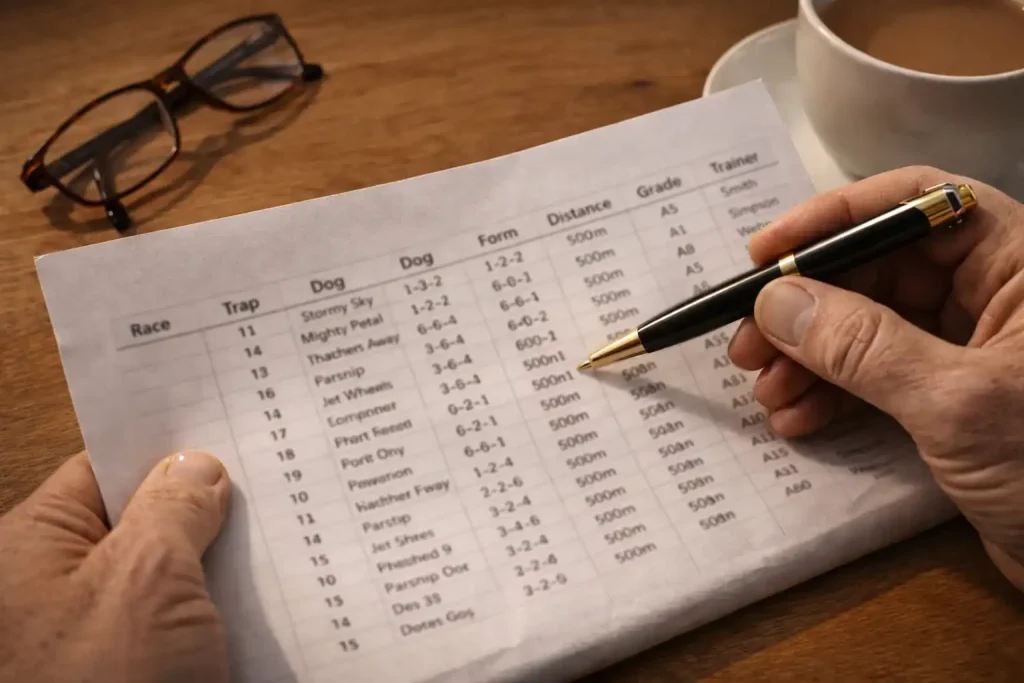
Form analysis at Oxford involves understanding both the general principles of greyhound form reading and the specific characteristics that make Oxford’s racing distinctive. The 379-metre circumference, the short run-up to the first bend, the particular running styles that thrive here—all of these factors should inform how you interpret past results and assess future chances. This guide covers the essentials of reading form with Oxford’s conditions in mind.
The wider context is set out in our Oxford greyhound results guide.
Form Line Basics
A form line presents a greyhound’s recent racing history in chronological order, typically showing the last six runs. Each entry includes the date, track, distance, trap number, finishing position, and winning time. Additional data often includes sectional times, margins, and comments describing the race narrative. Reading these lines fluently is the foundation of form analysis.
The trap number in a form line indicates where the greyhound started. At Oxford, trap positions matter more than at tracks with longer run-ups because the short distance to the first bend amplifies inside-trap advantages. When reviewing a greyhound’s form, note whether it has previously raced from the same trap it will occupy in the upcoming race. Consistent trap allocation may indicate the trainer’s assessment of the dog’s preferred starting position.
Finishing positions tell you where the greyhound ended up, but context matters. A third-place finish in A1 graded company may represent stronger performance than a win in A6. The grade at which each race was run—typically shown alongside the form line—provides essential context. Greyhounds moving up in grade face stiffer competition; those dropping down may find weaker fields more manageable.
Times require careful interpretation. Raw finishing times are affected by track conditions, and the going allowance on any given day can significantly alter what a time represents. Calculated times—which adjust for going—provide a fairer basis for comparison across different meetings. When Timeform and similar services publish calculated ratings, they have already factored in these adjustments. Raw times alone can mislead.
Common Abbreviations
Form guides use standard abbreviations to compress race narratives into manageable notation. Learning these shortcuts is essential for fluent form reading. Position abbreviations include “Ld” (led), “EP” (early pace, led early), “RlsUp” (rails up, ran near the inside rail), “Mid” (middle runner), “Wide” (ran wide of the field), and “Crd” (crowded, experienced interference). These tell you not just where the dog finished but how it ran the race.
Trouble indicators are particularly important. “Bmp” (bumped) signals contact with another greyhound. “Ck” or “Chkd” (checked) means the dog lost momentum, typically due to interference. “Fell” is self-explanatory but thankfully rare. “Blk” (baulked) indicates being impeded by another runner. When you see these abbreviations in recent form, consider whether the result reflects the greyhound’s true ability or was compromised by racing luck.
Running style abbreviations reveal tendencies. “Fst” (fast) often accompanies sectional time data to indicate strong early pace. “StrnFn” (strong finish) suggests a greyhound that closes well in the final stretch. “RlsRn” (rails runner) identifies dogs that naturally seek the inside line—valuable information at Oxford, where the tight bends reward railers. “WdRn” (wide runner) warns of a greyhound that drifts to the outside, potentially covering extra ground on Oxford’s 379-metre circuit.
Distance beaten abbreviations show margins in lengths or fractions: “½” (half a length), “1” (one length), “nk” (a neck), “sh” (a short head), “dht” (dead heat). When reading margins, remember that a length in greyhound racing represents approximately 0.08 seconds at racing speed. Small margins can reflect close finishes or suggest that a greyhound had more to give but wasn’t asked for maximum effort.
Reading Margins and Comments
Margins reveal how races unfolded and suggest where improvement might come. A greyhound beaten two lengths after leading to the last bend had the race in its grasp and was caught—possibly lacking stamina, or perhaps just collared by a faster finisher on the day. The same two-length deficit after trouble at the first bend tells a completely different story: interference cost ground that might otherwise have produced a winning margin.
First-bend positions carry statistical weight. Research suggests that the greyhound leading at the first bend wins approximately 35% of races across British tracks. At Oxford, where the tight circumference makes recovery difficult, that advantage may be even more pronounced. Form lines that consistently show a dog leading at the first bend indicate a greyhound whose early pace could be exploited—or, if it keeps getting caught, one with stamina limitations despite tactical advantages.
Comments in full form guides provide narrative context that abbreviations alone cannot capture. A note like “held up behind weakening leader” explains a mid-race position change. “Ran on well when clear” suggests the dog had more to offer once racing room appeared. These comments help you understand whether a modest finishing position disguises a promising run or whether a strong finish came against limited opposition. Context transforms raw data into actionable insight.
Track-specific form deserves special attention. When reviewing a greyhound’s Oxford form separately from its form at other venues, patterns may emerge. Some dogs thrive on Oxford’s tight turns; others struggle despite success elsewhere. The form line itself may not specify the track, but cross-referencing with meeting dates and distances allows you to identify Oxford-specific performance trends.
Applying Form to Betting
Form analysis supports betting decisions but does not guarantee them. Across British greyhound racing, favourites win approximately 35.67% of graded races—substantially better than random chance would suggest but far from certainty. The market aggregates many punters’ form assessments, meaning that obvious form conclusions are already reflected in prices. Value comes from reading form more accurately than the market consensus.
At Oxford specifically, apply what you know about track characteristics when reading form. A greyhound with a string of rail runs and early-pace abbreviations is well suited to Oxford’s geometry. A wide runner with strong finishes at larger tracks may find Oxford’s tight bends less accommodating. Form tells you what a dog has done; track knowledge tells you how that translates to the upcoming venue.
Weight recent form more heavily than older performances. Greyhounds improve and decline over time, and a strong race two weeks ago is more indicative than a win two months back. But also consider the context of that recent form—was it achieved in strong graded company or against weaker opposition? Was the track fast or slow? Did the greyhound encounter trouble that masked its true ability?
Building Your Form Reading Skill
Fluent form reading develops through practice. Start by studying racecards before meetings and making predictions based on form analysis alone. Then compare your assessments to outcomes. Where you were wrong, examine why—did you misinterpret the form, or did racing luck produce an unexpected result? This feedback loop builds skill over time.
Oxford’s form analysis rewards those who understand the track. The abbreviations are standard, but their implications vary by venue. Knowing that Oxford favours certain running styles, and recognising those styles in form lines, gives you an edge over punters who read form generically. Form at Oxford is specific to Oxford—treat it that way, and your analysis will sharpen accordingly.
The card it appears on is decoded in the racecard guide.
