
Oxford Stadium 450m Results: Performance Data for the Standard Distance
 Available in US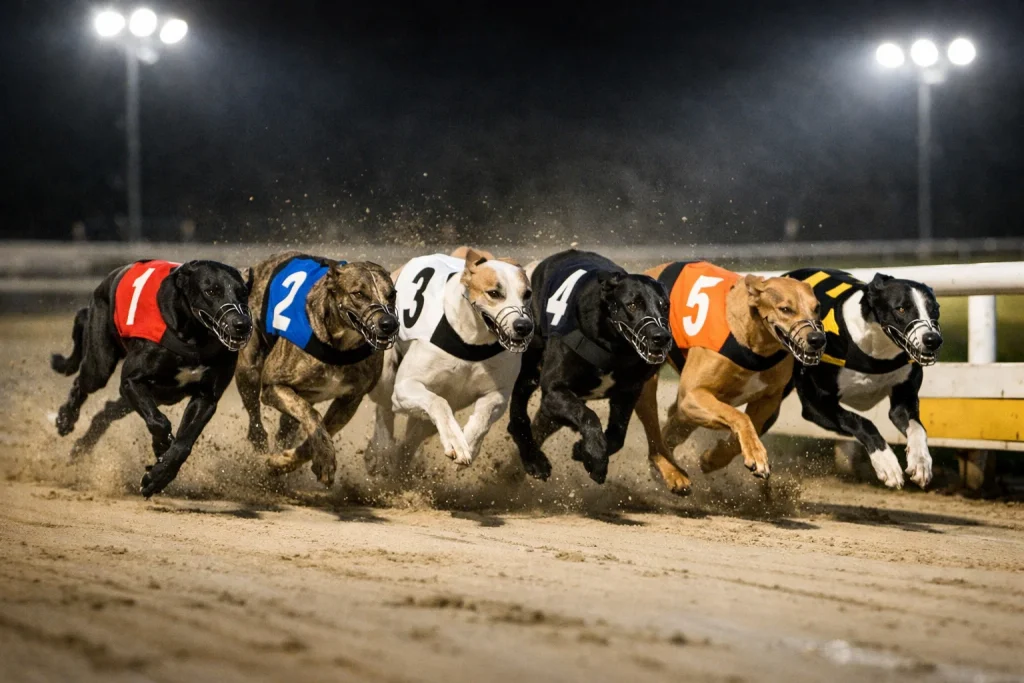
Understanding the 450m at Oxford means understanding the track itself. The distance requires dogs to navigate both bends twice, testing early pace, cornering ability, and stamina in a single race. It’s long enough to expose weaknesses in fitness, short enough that raw speed still matters. Oxford’s flagship 450m distance offers the most comprehensive dataset for form students, and this breakdown covers what the numbers reveal.
Oxford Stadium runs six racing distances—250, 450, 595, 645, 845, and 1040 metres—but the 450m is where consistency matters most. It’s the benchmark distance, the one against which all other performances are measured.
The wider context is set out in our Oxford greyhound results guide.
Why 450m Is the Standard
Every GBGB-licensed track in Britain designates a standard distance for graded racing, and at Oxford that distance is 450 metres. The reasoning is practical: standard distances allow meaningful comparison between dogs, provide consistent grading data, and generate the statistical depth needed for serious form analysis.
At 450 metres, the race unfolds in distinct phases. Dogs break from the traps and sprint approximately 108 metres to the first bend. They negotiate two full turns through the middle portion of the race, then drive through a run-in of roughly 160 metres to the finish. Each phase tests different attributes.
Shorter trips like the 250m sprint reward pure early speed but lack sample size for reliable assessment—dogs only face one bend, and the small margins make performances volatile. Longer distances at 595m and beyond test stamina but occur less frequently, limiting the available data. The 450m strikes the balance: enough complexity to reveal genuine ability, enough frequency to build form patterns.
For trainers, the 450m serves as the default assessment distance. New dogs to the track typically trial and race at 450 metres first, with moves to alternative distances coming only after their running style becomes clear. Early-pace specialists might drop to 250m; strong stayers might step up to 595m. But the 450m remains home base.
Typical 450m Times at Oxford
Calculated times over 450m at Oxford vary with grade, going, and individual dog quality, but a working framework helps contextualise any performance. Top-grade A1 runners at Oxford typically post calculated times around 27.80 to 28.20 seconds under standard going conditions. Mid-grade dogs in A5 or A6 races usually run between 28.60 and 29.20 seconds. Lower grades extend toward 30 seconds and beyond.
These figures represent calculated times—the adjusted values that account for going allowance and provide standardised comparison. Actual times vary with track conditions: faster going shaves tenths off raw times, while heavy going adds them. The calculated time irons out these fluctuations, making form comparison across different meetings meaningful.
Breaking down the 450m into sectionals, expect strong runners to reach the first bend in approximately 5.90 to 6.10 seconds. The bend section covering both turns typically adds around 13 to 14 seconds for graded dogs. The run-in from the final bend to the line takes roughly 8 to 9 seconds for fit greyhounds finishing strongly.
Track record performances are useful benchmarks but poor guides for typical racing. Record times represent outlier performances under perfect conditions—they tell you what’s possible, not what’s normal. Regular punters are better served understanding the standard time ranges for each grade and noting when individual dogs perform above or below those expectations.
Trap Bias at 450m
Trap draw affects 450m racing at Oxford, though the bias is less extreme than at sprint distances. Oxford Stadium’s blog analysis found that Trap 3 holds a statistical edge of approximately 2% over its nearest competitor across all distances, a margin that persists in the 450m data.
The reasoning relates to track geometry. Dogs in Trap 3 start close enough to the rail to claim inside running but have enough room to avoid crowding from the two inner boxes. They can break cleanly and angle toward the rail without the bumping that often affects Traps 1 and 2 in the opening strides.
Outside draws—Traps 5 and 6—face a longer path to the first bend. Over 450m, where that bend arrives after 108 metres, wide dogs must either burn extra energy sprinting for position or settle for covering more ground through both turns. Neither option is ideal.
The practical application is straightforward: all else being equal, favour inside and middle draws over outside draws in 450m races. A dog dropping from Trap 6 to Trap 2 with similar opposition represents better value than the form figures alone suggest. Conversely, a dog moving from Trap 1 to Trap 6 faces a harder task than headline form indicates.
This doesn’t mean outside draws never win. Dogs with strong early pace can offset the draw disadvantage by establishing position before the first bend. But when assessing form, factor trap draws into calculated-time comparisons. A 28.50 from Trap 1 and a 28.60 from Trap 6 might represent equivalent ability.
Grading at 450m
Oxford uses the standard A-grade system for 450m racing, with A1 representing the fastest dogs and grades descending through A2, A3, and so on down to A11 for the slowest runners. Each grade corresponds to a calculated-time band, and dogs move between grades based on recent performance.
A win typically earns an upgrade; consistent poor finishes trigger a downgrade. The grading system aims to produce competitive racing by matching dogs of similar ability. When a dog is correctly graded, it faces genuine competition and produces informative form. When a dog is outgrading—faster than its current grade—it represents value until the racing office adjusts.
Reading 450m results with grading in mind means noting not just finishing position but whether the dog is rising or falling through the grades. A fourth-place finish in A4 company might be more impressive than a win in A8. The calculated time tells part of the story; the grade context tells the rest.
For betting purposes, dogs stepping up in grade after a win often face stiffer competition than their previous performance suggested. Meanwhile, dogs dropping in grade after a poor run might have encountered bad luck—interference, wide running, illness—and now meet easier opposition. Neither situation is automatic value, but both warrant closer examination of the sectional data.
Conclusion
The 450m distance at Oxford provides the most consistent and data-rich environment for greyhound form study. The distance tests speed, cornering, and stamina in a single race while generating the frequent results needed for meaningful analysis. With Oxford offering six racing distances—250, 450, 595, 645, 845, and 1040 metres—the 450m remains the reference point against which performances at other trips are measured.
The sprint trip is analysed in 250m results.
Understanding typical time ranges by grade, recognising how trap draw influences performance, and reading grade context into results transforms raw finishing positions into actionable form data. The statistical edge that Trap 3 holds—approximately 2% over its nearest competitor—compounds across a season of betting, making draw assessment essential rather than optional.
For Oxford regulars, mastering the 450m is the foundation of everything else. The patterns you learn here transfer to other distances, and the form database you build becomes increasingly valuable with each meeting you analyse.
