
Calculated Time vs Actual Time: How Oxford Results Are Standardised
 Available in US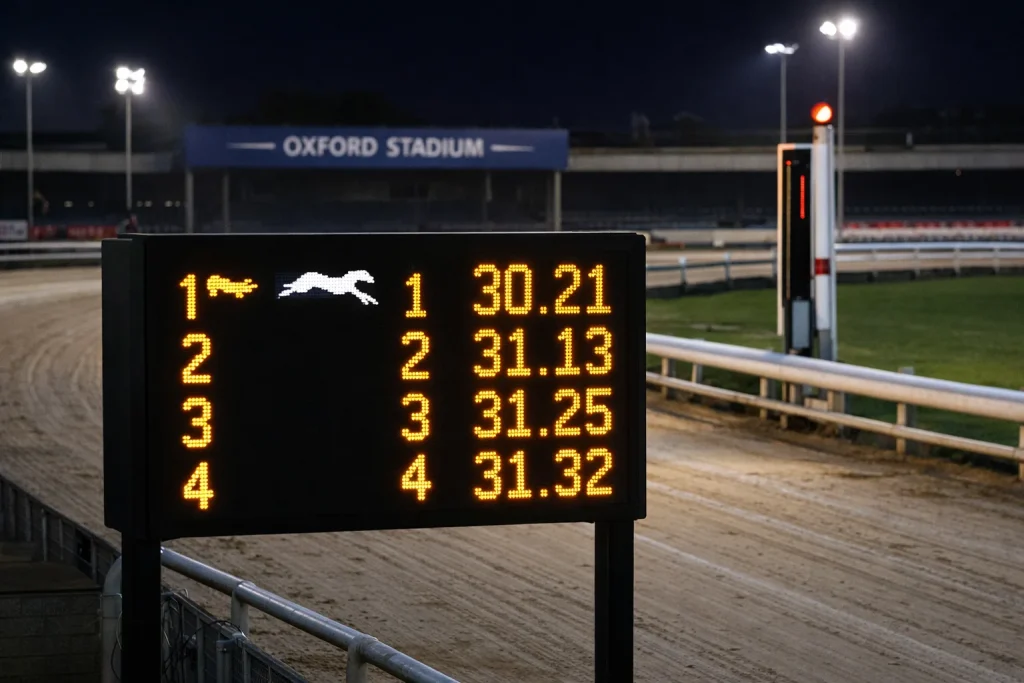
Oxford’s 379-metre circumference creates specific timing dynamics, especially through its tight first bend at 108 metres. Understanding how times are standardised here transforms a column of digits into actionable intelligence. This article breaks down the formula, explains when calculated time matters most, and identifies the scenarios where actual time tells you more than any adjustment ever could.
The wider context is set out in our Oxford greyhound results guide.
Why Calculated Time Exists
Greyhound racing would be chaos without standardisation. Weather changes track surface. Temperature shifts sand consistency. Rain slows dogs down while dry, warm evenings see them fly. Without some adjustment, comparing a dog’s Tuesday run to its Saturday performance becomes guesswork.
The concept emerged because trainers and bettors needed a neutral benchmark. If Oxford hosts twelve meetings a month with varying conditions, how do you decide which dog is genuinely fastest? Actual time alone penalises dogs who raced on slow evenings and flatters those lucky enough to run on fast nights. Calculated time strips away the environmental noise, isolating the dog’s true ability.
Regulatory bodies including GBGB worked on standardising these adjustments across licensed tracks. Consistent methodology ensures that grading decisions and performance ratings reflect genuine form rather than conditions beyond any greyhound’s control.
The Formula Explained
The calculation hinges on going allowance, a correction factor derived from trial runs before each meeting. Tracks send out control dogs under known conditions to establish a baseline. If the trial dog runs 0.15 seconds slower than its standard time, the going allowance for that meeting becomes +0.15. Every finishing time that evening gets reduced by 0.15 to produce the calculated time.
At Oxford, the calculation runs as follows: Calculated Time = Actual Time minus Going Allowance. A greyhound recording 28.50 actual on a meeting with a +0.20 allowance yields a calculated time of 28.30. That number represents what the dog would theoretically run under standard conditions.
Several factors influence the going allowance. Rain adds moisture to the sand, increasing resistance and slowing dogs down. Temperature affects both track firmness and the greyhound’s muscle efficiency. Wind direction, particularly headwinds down the home straight, adds fractions of a second that the allowance absorbs. Oxford’s maintenance team monitors surface depth and consistency using penetrometer readings, ensuring that the allowance accurately reflects conditions rather than approximating them.
The formula has limits. It assumes uniform conditions across all six traps and both bends. When localised patches of soft sand exist or when the rail line runs faster than the middle of the track, the blanket adjustment cannot capture those variations. Smart form readers note the going allowance but also watch replays for visual cues the formula misses.
Timeform and other data providers use calculated times as the foundation for their speed ratings. A dog consistently posting calculated times around 28.00 over 450 metres carries a different profile from one fluctuating between 27.80 and 28.40. Consistency in calculated time suggests reliable form; volatility hints at sensitivity to conditions the going allowance does not fully correct.
Comparing Dogs Across Meetings
Calculated time earns its keep when analysing dogs from different meetings. Consider two greyhounds entered in the same race: one last ran at Oxford three weeks ago on a slow evening with a +0.25 going allowance, posting 28.55 actual. The other raced last Tuesday on a fast track with a -0.10 allowance, recording 28.10 actual. At first glance, the second dog looks 0.45 seconds quicker. After applying the going allowance, their calculated times sit at 28.30 and 28.20 respectively. The gap shrinks to 0.10 seconds, a far more accurate reflection of their relative ability.
This matters enormously for grading. Oxford uses calculated times to determine which grade a dog belongs in. A greyhound posting a 28.00 calculated time slots into a different band than one managing only 28.60. The racing manager uses these adjusted figures to create competitive fields where dogs of similar ability compete against each other. Without calculated time, grading would rely on raw numbers that reward lucky conditions rather than genuine speed.
Data from across UK tracks shows that the greyhound leading at the first bend wins approximately 35% of races. That statistic holds when calculated times are used to assess early pace. A dog consistently reaching the first bend in 5.20 seconds calculated demonstrates reliable early speed regardless of when or where it raced. Comparing sectional splits via calculated time reveals which dogs genuinely possess pace rather than which simply raced on fast nights.
For bettors, calculated time comparisons help identify value. When the favourite’s recent calculated times barely edge out a longer-priced rival, the market may have overreacted to impressive actual times that flattered the going. Conversely, a dog whose calculated times look modest might simply have raced repeatedly on slow tracks, masking genuine ability the market underrates.
When to Trust Actual Time
Calculated time is not infallible. Situations arise where actual time tells you more about what happened than any formula can capture. Track records, for instance, only recognise actual times. When a greyhound breaks the 450-metre record at Oxford, the going allowance is irrelevant; the clock showed what it showed.
Same-meeting comparisons also favour actual time. If two dogs raced on the same card, they experienced identical conditions. The going allowance cancels out, so comparing their actual times directly makes sense. A dog beating its rival by three lengths and 0.30 seconds on the night demonstrated superiority under those specific conditions, and no adjustment changes that outcome.
Watch for meetings where the going allowance feels wrong. Occasionally the trial dog produces an anomalous run, skewing the allowance for the entire card. If a particular meeting’s results seem uniformly faster or slower than form suggested, the going calculation may have missed something. Experienced punters check whether the allowance aligns with observed race dynamics before trusting calculated times from that meeting.
Actual time also matters for assessing a dog’s response to specific conditions. Some greyhounds thrive on rain-softened tracks while others struggle. If a dog’s actual times improve relative to rivals when conditions turn heavy, that pattern has predictive value the going allowance obscures. Noting how a greyhound performs across different going conditions builds a richer picture than relying solely on standardised figures.
Conclusion
Calculated time and actual time serve different purposes. The former enables fair comparisons across varying conditions, underpinning grading decisions and form analysis. The latter captures what actually happened on a given night, useful for same-meeting comparisons and understanding a dog’s response to specific environments. Neither number tells the whole story alone.
The weather element is the going allowance.
At Oxford, where the 379-metre track sees diverse weather throughout the year, understanding both measurements gives you an edge. Check the going allowance, compare calculated times for cross-meeting analysis, but do not ignore actual times when evaluating dogs who raced on the same card or who consistently outperform their adjusted figures under certain conditions. The punters who profit long-term are those who know which number to read and when.
