
Oxford 250m Sprint Results: Why Early Pace Dominates Short Races
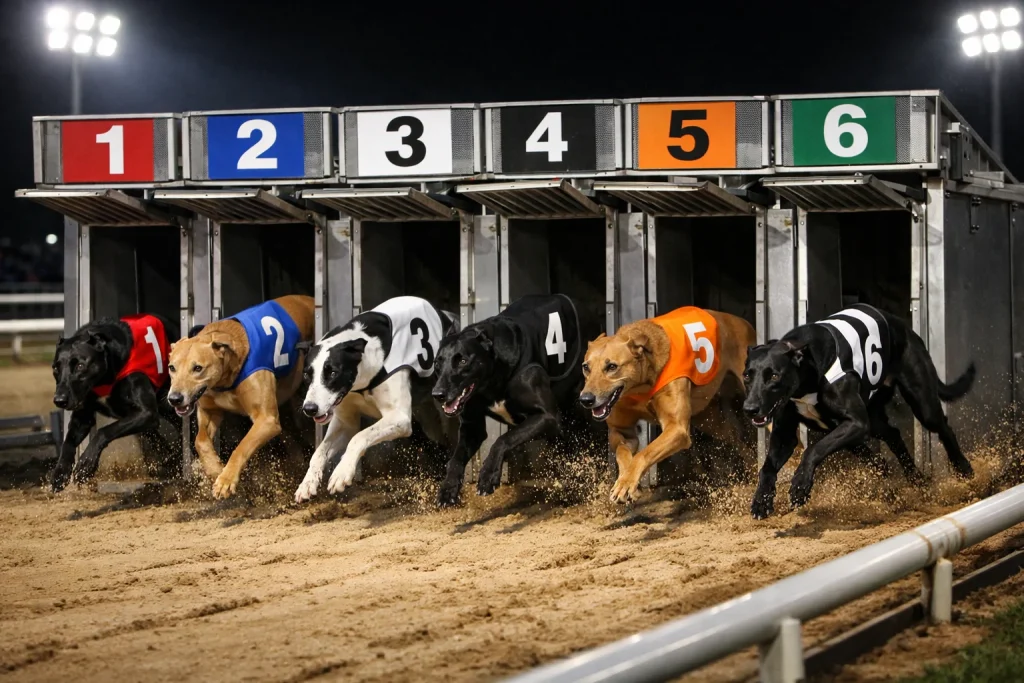
Sprint racing strips greyhound competition down to raw speed. At 250 metres, Oxford Stadium’s shortest distance, there is no room for a slow starter to recover. The dogs explode from the traps, hit one bend, and cross the finish line before a mid-distance runner would even find their rhythm. Everything happens in roughly fourteen to sixteen seconds, leaving no margin for tactical manoeuvring or stamina-based comebacks.
Oxford offers 250m races as part of its distance range, alongside the standard 450m and longer trips up to 1040m. These sprints attract a specific type of greyhound: quick out of the boxes, sharp around the first bend, and brave enough to hold position when rivals crowd the rail. Understanding what separates a genuine 250m specialist from a dog merely racing below its optimal distance transforms how you read sprint racecards.
250m Race Characteristics
The 250m distance at Oxford involves a straight run from the traps to the first bend, followed by one turn and a short finishing straight. Unlike the standard 450m, which features two bends and allows stronger runners to grind down early leaders, the sprint format rewards immediate acceleration above all else. A dog that breaks half a length ahead often maintains or extends that advantage to the line.
Reaction time matters more here than at any other distance. The moment the lids fly up, milliseconds determine positions. A greyhound with a quick break gains precious ground before rivals even reach full stride. Trainers condition sprint specialists for explosive starts, sometimes at the expense of stamina that would benefit them over longer trips.
Bend speed also plays a role, though less prominently than at 450m where the second bend creates additional challenges. The single turn in a 250m race still favours dogs who corner tightly without losing momentum. Wide runners find themselves covering extra ground they simply cannot afford over such a short distance. The geometry penalises anything other than rail-hugging efficiency.
The finishing straight is brief. By the time greyhounds exit the bend, only a short run remains. Dogs with strong finishing kicks rarely have time to deploy them. The race is effectively decided by the halfway point, making early pace indicators the most reliable predictors of sprint outcomes.
Trap Bias at 250m
Inside traps carry significant advantages over 250 metres. Trap 1 greyhounds start closest to the rail and need only run the shortest path around the single bend. Across UK tracks, Trap 1 typically shows a win percentage around 18 to 19 percent, exceeding the theoretical average of 16.6 percent. At sprint distances, this bias intensifies further because there is less race distance for outside dogs to work their way in.
Trap 2 and Trap 3 also benefit from inside positions. Dogs drawn here can aim for the rail early, angling in before reaching the bend. A clean break from these traps often translates into first-bend leads that hold to the finish. Trap 3 frequently emerges as the highest-performing trap statistically, carrying an edge of approximately two percent over its nearest competitors.
Wide traps face structural challenges at 250m. Trap 6 dogs must either cross inward quickly, risking interference, or swing wide around the bend, adding metres to their journey. In a race lasting fifteen seconds, those extra strides prove costly. Unless a wide trap houses a markedly superior sprinter, the draw disadvantage suppresses its chances noticeably.
Smart punters weight trap draw heavily when assessing 250m races. A quick Trap 1 dog with solid early pace represents a different proposition than the same dog drawn in Trap 5. Form figures compiled across all distances can mislead if you ignore the amplified trap effects that sprint racing introduces.
Sectional Profiles
Sectional times reveal more about sprint prospects than finishing times alone. The split to the first bend tells you which dogs possess genuine early speed. A greyhound reaching the bend in 4.90 seconds holds a clear advantage over one arriving in 5.10 seconds. That 0.20 second gap translates into roughly a length and a half, an almost insurmountable lead in a 250m race.
Consistency in sectional times matters as much as raw speed. A sprinter who posts 4.95 to the bend across five consecutive races demonstrates reliable early pace. One whose times fluctuate between 4.90 and 5.20 introduces unpredictability that complicates form assessment. The steady performer offers better betting value because you know what to expect.
Run-in times, the split from the final bend to the finish, carry less weight at 250m than at longer distances. By the time dogs exit the turn, positions are largely fixed. A dog with a strong finishing kick cannot overcome a two-length deficit in forty metres of straight. Focus your sectional analysis on the early portion of the race where outcomes are decided.
As GBGB CEO Mark Bird noted: “As a licensed sport, we can ensure greyhounds benefit from the care and attention they deserve and have far more protection than domestic pets. Moreover, we have the data to prove our welfare standards are strong.” This licensing framework means Oxford Stadium maintains accurate timing and performance systems, ensuring the sectional splits you analyse reflect genuine ability rather than measurement inconsistencies. Reliable data underpins confident betting decisions.
Betting on Sprints
Sprint races favour favourites more than middle-distance events. The reduced race duration limits the opportunities for upsets. If the quickest dog breaks cleanly and corners efficiently, few scenarios allow a slower rival to overtake. Favourites at UK tracks win approximately 35.67 percent of graded races on average, but sprint distances often push that figure higher when clear early-pace advantages exist.
Forecast betting suits sprints well. With trap bias amplified and early pace dominant, identifying the probable first and second finishers becomes more straightforward than in longer races with multiple tactical phases. A forecast combining the quickest inside trap with the best wide-runner offers defined value if both dogs perform to their sectional averages.
Tricast betting grows riskier at 250m. The narrow field spread and rapid race completion mean slight variations in break timing can shuffle the minor placings unpredictably. A dog finishing third in one race might finish fifth in the next despite identical runs, simply because rivals broke marginally better. Unless dividends compensate generously for this volatility, straight win or forecast bets often provide better returns.
Watch for sprint specialists dropping down from 450m. Trainers sometimes enter dogs in shorter races to rebuild confidence or exploit a perceived speed advantage. These drops can deliver winners at decent prices if the dog genuinely possesses early pace that standard-distance racing masked. Conversely, stayers entered in sprints to gain experience rarely threaten against genuine 250m performers.
Conclusion
The 250m distance at Oxford Stadium rewards early pace above everything else. Trap draw advantages intensify because the single-bend format leaves little room for wide runners to recover. Sectional times to the first bend predict outcomes more reliably than overall finishing times. And betting markets that favour clear speed advantages make sprint races fertile ground for punters who read form correctly.
Approach 250m racing with different expectations than middle-distance events. The compressed format compresses variables too. Fewer things can go wrong for the fastest dog, which means form holds more consistently than over longer trips. If you identify a genuine sprint specialist drawn in an inside trap with proven early pace, you have found the type of selection that builds long-term profit.