
Oxford Greyhound Results Archive: Search Past Races by Date & Distance
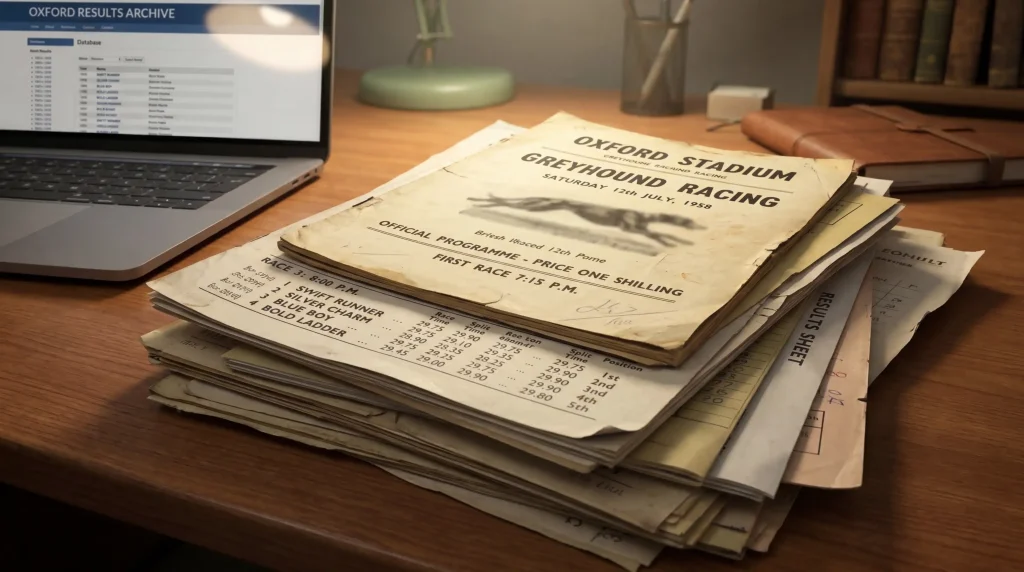
Historical results transform greyhound betting from guesswork into analysis. The Oxford Stadium archive contains every race run since the track reopened in September 2022, along with records from its previous operational period before the December 2012 closure. With 17 BAGS-contracted tracks generating more than 25,000 races annually across the UK, Oxford’s contribution to this archive provides substantial data for form study. Accessing this data allows punters to track individual greyhounds across their careers, identify patterns in trainer performance, and build the contextual knowledge that separates informed selections from hopeful punts.
Finding past results requires knowing where to look and how to search efficiently. Multiple sources hold Oxford racing data, each with distinct strengths and limitations. This guide navigates the available archives, explains effective search techniques, and demonstrates how historical records inform future betting decisions.
Where to Find Archives
The GBGB maintains the official results database for all licensed UK tracks, including Oxford Stadium. This authoritative source records finishing positions, times, going allowances, and trap draws for every race run under GBGB jurisdiction. The database covers current racing and extends back through years of historical records, providing the most comprehensive official archive available.
Timeform offers comprehensive archives with enhanced analytical features. Beyond raw results, Timeform provides ratings, sectional times, and form commentary that contextualises each performance within broader patterns. Subscription-based access unlocks deeper historical search capabilities and comparison tools that free sources cannot match, making the investment worthwhile for serious form students.
Racing Post maintains greyhound results alongside its extensive horse racing coverage. The searchable archive allows filtering by track, date, and distance, making it straightforward to isolate Oxford-specific records quickly. Racing Post also provides racecard archives showing how fields were composed and what markets predicted before races ran, useful for understanding how expectations matched outcomes.
Oxford Stadium’s own website offers results from recent meetings. While less comprehensive than dedicated databases covering longer timeframes, the official track source provides quick access to the latest cards without navigating external platforms. For immediate post-meeting analysis, the stadium site often updates fastest.
Third-party aggregators compile results across multiple tracks, presenting data in formats optimised for specific analytical approaches. Some focus on statistical summaries with charts and graphs; others emphasise individual greyhound tracking with career timelines. Exploring several sources reveals which interface suits your particular analytical preferences and workflow.
How to Search Effectively
Searching by greyhound name retrieves complete career records for individual dogs. This approach suits tracking a specific runner’s form progression, identifying preferred distances, and noting performances at different tracks. Name searches reveal whether a dog has raced at Oxford before and how it performed on this specific track.
Date-based searches isolate specific meetings. If you recall a notable race but not the participants, searching by date reconstructs the card. This technique helps when building long-term records of track conditions on particular dates or when verifying memories against documented outcomes.
Distance filters narrow results to specific trip categories. Searching Oxford results at 450m only, for instance, removes sprint and staying races from consideration. Distance filtering helps when analysing trip-specific patterns or when a dog’s form at one distance differs substantially from its record elsewhere.
Trainer and kennel searches reveal patterns in how specific operations perform at Oxford. A trainer sending dogs to Oxford regularly builds a track-specific record distinct from their overall statistics. Filtering by trainer name shows this local performance history.
Combining multiple filters sharpens searches further. A query for a specific trainer’s 450m runners at Oxford over the past six months produces precisely targeted results. Such focused searches answer specific analytical questions rather than generating overwhelming data volumes.
Using Archives for Form
Recent form matters most, but historical context shapes interpretation. A dog winning three consecutive races looks impressive until archive searches reveal it lost twenty straight before the current streak. Context distinguishes genuine improvement from variance and lucky sequences from sustainable performance levels that will continue delivering results.
Track-specific form deserves particular attention. Some greyhounds perform significantly better at Oxford than elsewhere, while others consistently underperform on this track despite strong records at different venues. Archives reveal these patterns through head-to-head comparisons between Oxford runs and performances at other stadiums. A dog with moderate overall statistics but excellent Oxford-specific form becomes a value proposition when racing here.
Seasonal patterns emerge from extended historical analysis. Certain dogs race better during winter months while others peak in summer conditions. Temperature affects both track conditions and canine physiology, altering performance characteristics across the year. Multi-year archives spanning different seasons expose these tendencies that single-season records cannot capture.
Head-to-head records matter when familiar rivals meet repeatedly. At tracks like Oxford with relatively small pools of regular competitors, the same dogs often race against each other multiple times per month. Archives show who won previous meetings, under what conditions, and by what margins. These direct comparisons sometimes predict future outcomes more reliably than abstract ratings or general form assessments.
Watch for form reversals after layoffs. Dogs returning from breaks often need runs to regain race fitness that training alone cannot replicate. Archives show how specific greyhounds have historically performed when fresh versus after several consecutive races. Some dogs fire immediately upon return, ready to race competitively from day one. Others require multiple outings before reaching peak form, their first runs back serving as preparation rather than genuine trials of ability.
Distance experiments appear in archives. When trainers test dogs at unfamiliar trips, the results inform future distance choices. A dog tried once at 845m and finishing exhausted clearly lacks staying ability; one closing strongly suggests the longer trip might suit better than current assignments. These exploratory runs provide intelligence that shapes subsequent race planning.
Limitations & Gaps
Oxford’s decade-long closure between December 2012 and September 2022 creates a significant gap in continuous records. Dogs racing before closure have no Oxford form in the intervening years, and the track’s characteristics may have changed following renovations. Pre-closure records provide historical interest but limited predictive value for current racing.
The UK once operated over 77 licensed greyhound tracks, but only 21 GBGB-licensed venues remain active today—19 in England, 1 in Wales, and 1 in Scotland. This contraction means historical data from closed tracks becomes increasingly irrelevant as the dogs who raced there retire. Archives preserve these records, but their practical utility diminishes over time.
Data quality varies between sources. Official GBGB records maintain high accuracy, but third-party aggregators sometimes contain errors introduced during data transfer. Cross-reference critical information across multiple sources when precise details matter, particularly for historical records where verification grows more difficult.
Sectional times became standard only relatively recently at some tracks. Earlier archives may lack the detailed split data that modern form analysis relies upon. For historical comparisons, available metrics constrain what analysis is possible.
Conclusion
The Oxford Stadium results archive provides the raw material for serious form analysis. Knowing where to search, how to filter effectively, and what patterns to seek transforms historical data into predictive insight. The greyhounds racing tonight have records stretching back through months or years of competition; that history informs their prospects today.
Use archives routinely rather than occasionally. Building familiarity with Oxford’s regular runners, their preferred conditions, and their competitive histories takes time but pays dividends. When you recognise a dog’s name and know its track-specific record before consulting the racecard, you have reached the analytical level where informed betting becomes possible.