
Favourites at Oxford Stadium: Win Rates & Finding Value Beyond the Market
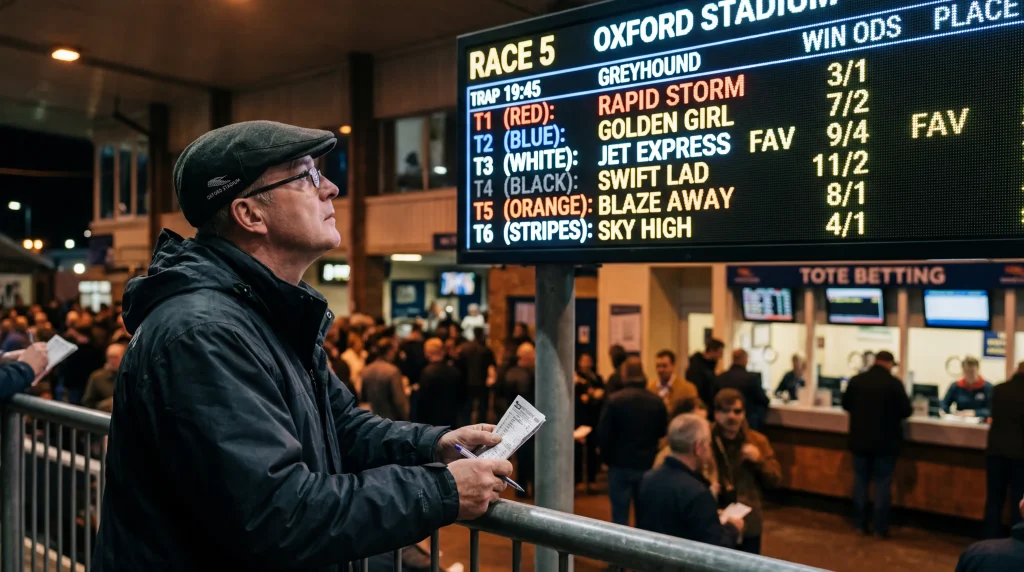
Backing favourites sounds like the safe option, but mathematics complicates that intuition. At Oxford Stadium, market leaders win often enough to seem reliable yet lose frequently enough that blind support destroys bankrolls. Understanding exactly how often favourites win, and at what prices, reveals when backing them makes sense and when seeking value elsewhere proves more profitable.
The favourite performance question matters because it shapes entire betting strategies. Some punters build approaches around consistent favourite backing; others systematically oppose them seeking longer-priced alternatives. Neither strategy succeeds without accurate data. This article examines Oxford’s favourite statistics, compares them to UK averages, and identifies scenarios where market leaders offer genuine value versus where the crowd has overpriced them.
Oxford Favourite Stats
Across UK greyhound tracks, favourites in graded racing win approximately 35.67% of races. This figure represents a substantial premium over the 16.6% expected if finishing positions were randomly distributed, confirming that markets correctly identify the most likely winner more often than not. At Oxford Stadium, performance tracks closely to this national average, neither significantly exceeding nor falling short of typical expectations.
A 35.67% strike rate means favourites lose nearly two of every three races. Punters expecting favourites to win routinely face disappointment; the majority of races see market leaders beaten by rivals the crowd considered less likely. This losing majority shapes bankroll requirements and staking approaches for anyone building strategies around favourite backing.
The critical question is not whether favourites win frequently, but whether they win frequently enough at their prices to generate profit over time. A favourite winning 35% of races at even money would be hugely profitable. The same dog at 1/3 would generate devastating long-term losses despite frequent winners. Oxford’s favourites typically price somewhere between these extremes, and the exact average price determines whether backing them systematically produces gains or losses.
At OLBG Greyhound Tips, analysis across UK tracks shows the relationship between favourite strike rate and prevailing odds varies by track. Oxford’s competitive racing produces favourites at slightly longer average prices than some lower-grade venues, creating occasional value opportunities when genuinely strong dogs price longer than their true probability suggests.
Grade influences favourite reliability substantially. In lower grades with wider ability gaps between runners, the best dog on paper wins more frequently. At higher grades where all runners hold genuine credentials, favourites face stiffer competition and convert less reliably. Oxford’s grading system creates competitive fields that test favourite credentials across all levels, preventing any single kennel or dog type from dominating predictably.
Comparing to UK Average
Favourite performance varies significantly across UK tracks. Data shows Kinsley operates as the most competitive venue, where favourites win just 31.6% of races, below national average. At the opposite extreme, Valley sees favourites winning 42% of contests, substantially above average. Oxford sits closer to the centre of this distribution.
Track characteristics influence these variations. Tighter tracks with more congested first bends see more interference that disrupts expected outcomes. Tracks with longer runs to the first turn allow clean racing that favours form horses. Oxford’s 108 metres to the first bend creates moderate crowding that sometimes upsets favourites but allows them to perform to expectation more often than at the most chaotic venues.
Field composition also matters. Tracks attracting deeper trainer pools produce more competitive races where second and third favourites can upset. Venues dominated by one or two powerful kennels see their dogs sent off favourite repeatedly and winning at elevated rates. Oxford draws trainers from across the southern England circuit, creating balanced competition.
Pool liquidity affects pricing accuracy. Tracks with heavy betting volume see prices settle at levels reflecting true probability more precisely. Thinner markets allow pricing anomalies to persist. Oxford’s BAGS coverage ensures reasonable liquidity, though smaller than the highest-profile venues, creating a middle ground where mild mispricings occasionally appear.
When to Back Favourites
Favourites deserve support when multiple positive factors align convincingly. A dog with superior recent form, favourable trap draw, proven early pace, and an in-form trainer represents a favourite with genuine substance behind its market position. When the price reflects all these advantages appropriately, backing makes sense; when the price seems excessively short relative to the advantages, looking elsewhere proves wiser.
Short-priced favourites rarely offer value. A dog at 1/2 needs to win 67% of races just to break even over time. Even the most impressive favourite at Oxford cannot sustain that strike rate over meaningful sample sizes. Systematic backing of odds-on favourites guarantees long-term losses despite the satisfying frequency of winners cashing.
Longer-priced favourites occasionally represent genuine value. When a deserving favourite drifts to 2/1 or longer due to one large stake elsewhere in the field distorting the market, sharp punters recognise the opportunity. These scenarios require real-time market monitoring rather than accepting early prices or final starting prices without understanding the context behind the movements.
Race type influences favourite prospects substantially. In graded races with evenly-matched fields, favourites face genuine competition from multiple credible rivals. In open races with class droppers or obvious standout performers, favourites convert at elevated rates reflecting their clear superiority. Distinguishing race types before applying favourite strategies improves outcomes substantially compared to treating all races identically.
Finding Value Elsewhere
When favourites seem overpriced by the market, value exists on second and third choices. Dogs with comparable form but longer prices offer better mathematical propositions. Identifying when the favourite lacks clear superiority points toward these alternatives.
Early pace analysis sometimes contradicts market opinion. If the favourite lacks early speed while a longer-priced rival consistently reaches the first bend ahead, early pace advantage may outweigh the form credentials that set the market. These disagreements between market and pace projections create exploitable angles.
Trap draw reversals offer opportunities. A favourite drawn wide against an inside-drawn rival with similar form faces disadvantages the market may not fully price. The inside dog at twice the favourite’s price can represent genuine value in scenarios where trap draw proves decisive.
Trainer patterns reveal situational value. Some trainers send out favourites that consistently underperform expectations; others develop underrated dogs who outperform their prices. Historical trainer analysis uncovers these systematic patterns that casual bettors miss.
Forecast and tricast betting sidesteps the favourite question partially. When you believe the favourite will finish placed but are uncertain about the winner, combinations excluding the favourite from first but including it second or third can produce value. This approach captures expected favourite competitiveness without requiring them to win outright.
Conclusion
Favourites at Oxford Stadium win roughly 35-36% of races, closely matching UK averages for graded greyhound racing. This strike rate confirms their relative quality without suggesting they represent automatic betting propositions regardless of price. The odds at which favourites trade determine profitability, and at typical prices, systematic favourite backing produces marginal results at best.
Build your approach around identifying when favourites offer genuine value versus when alternatives deserve preference. Strong favourites at reasonable prices merit support when form, pace, and draw align. Weak favourites at short prices invite opposition through backing longer-priced rivals or avoiding the race entirely. This distinction, rather than blanket favourite backing or blanket favourite opposition, characterises profitable long-term betting strategies at Oxford and beyond.