
Oxford Tricast Betting: Maximise Returns with Smart Combinations
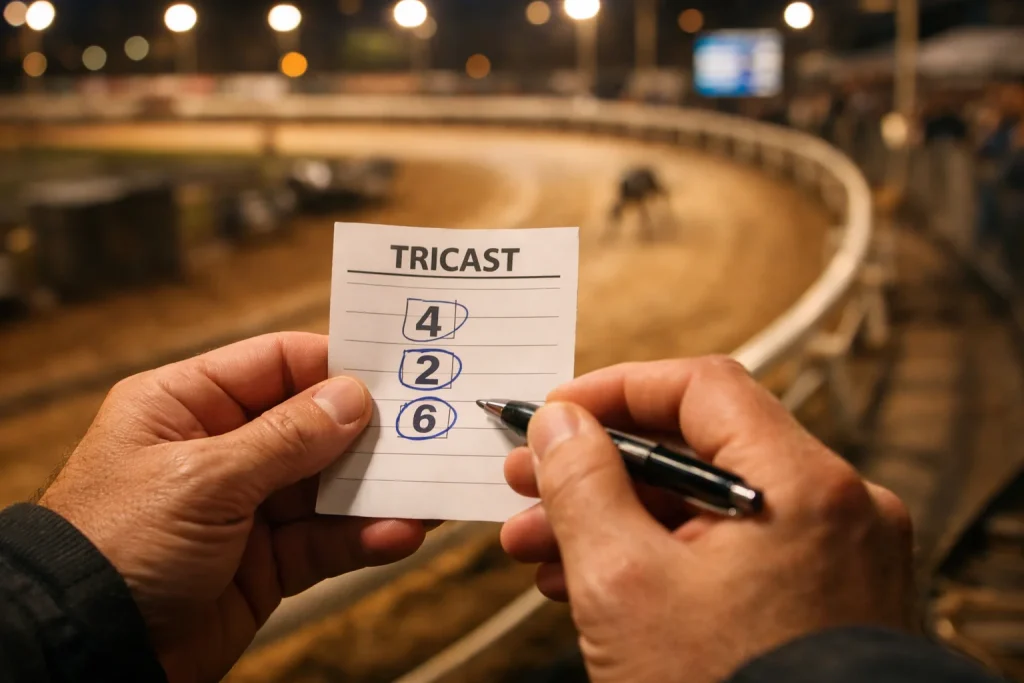
If forecast betting is the entry point for exotic wagers at greyhound tracks, then the tricast is where things get genuinely interesting. Picking the first two finishers in exact order requires skill and a dash of luck. Picking the first three in exact order? That requires a methodology.
Oxford Stadium offers a compact, fast circuit that punishes crowding at the bends and rewards tactical positioning. These characteristics create distinctive finishing patterns that, when understood, can make tricast betting less of a lottery and more of an informed pursuit. The dividends can be substantial. A straight tricast on a six-dog race with no clear favourite has paid out over £500 on more than one occasion at Oxford. But chasing big numbers without a plan is the quickest route to an empty wallet.
This guide breaks down how tricasts work at Oxford, what they cost, and how to structure combinations that balance ambition with bankroll reality.
Tricast Explained
A tricast bet requires you to predict the first, second, and third finishers in a race, in the correct order. Unlike a forecast, which covers only two dogs, the tricast adds a third variable, dramatically increasing both difficulty and potential reward.
In a standard six-runner greyhound race, there are exactly 120 possible tricast outcomes. That is six options for first, five remaining for second, and four remaining for third: 6 × 5 × 4 = 120. Your straight tricast is one of those 120 combinations. The mathematical improbability is precisely what drives the dividends.
Tricast dividends at UK tracks, including Oxford, are calculated using the Tote pool system. All money wagered on tricasts for a given race is pooled together. After the standard deduction (typically around 26% for the Tote), the remaining pool is divided among winning tickets. This means your payout depends not just on the result but on how many other punters backed the same combination. An obvious favourite finishing first, followed by the second and third choices in the betting, produces a lower dividend. A result that nobody saw coming? That is where the three-figure and occasionally four-figure returns live.
One key distinction: at Oxford, tricast betting is available on every race with six runners. Races with fewer runners typically do not offer tricast pools, though some betting shops may offer computer straight forecast and tricast options that calculate returns using a formula rather than a pool.
Cost Calculations
Straight tricasts are simple: one combination, one unit stake. A £1 tricast on dogs 3-2-5 (trap three finishing first, trap two finishing second, trap five finishing third) costs £1. If you are confident in your selections and want to chase a bigger dividend, this is the cheapest approach.
Combination tricasts, however, require understanding permutations. If you fancy three dogs but cannot separate them, a full cover combination includes every possible arrangement of those three finishing in the top three positions. Three dogs produce six permutations: ABC, ACB, BAC, BCA, CAB, CBA. A £1 unit stake on a full perm with three dogs costs £6.
The cost escalates quickly as you add more selections. Four dogs in any order across the first three positions generates 24 permutations, costing £24 at £1 per line. Five dogs means 60 permutations and a £60 outlay. Six dogs covering all possibilities would cost £120, at which point you might as well not bother since you are guaranteed to win but almost certainly guaranteed to lose money after the pool deductions.
Partial combinations offer middle ground. You might have a strong conviction that one dog wins, but uncertainty about second and third. Boxing your banker in first position with four other dogs contesting second and third gives you 12 permutations: 1 × 4 × 3 = 12. At £1 per line, that is £12 instead of the £60 you would spend letting all five dogs float anywhere.
Understanding these costs is fundamental. A clever tricast strategy is not just about picking the right dogs. It is about structuring your combinations so that when you hit, the return justifies the investment.
Oxford Tricast Patterns
Oxford’s 379-metre circumference creates specific racing dynamics that influence tricast outcomes. The track is tight, and the first bend arrives quickly, particularly over the standard 450-metre distance. Dogs that lead into the first bend hold a structural advantage through reduced interference. Data from Timeform analysis suggests that the first-bend leader wins approximately 35% of races across UK tracks, and Oxford, with its sharp bends, sits at the upper end of that range.
This translates into tricast thinking: early pace matters. A dog with strong sectional times to the first bend often warrants consideration for first place, even if its overall graded time is not the fastest in the field. Conversely, dogs known for late finishes face the challenge of navigating traffic, and while they might surge into second or third, predicting exactly where they place becomes more variable.
Trap position plays into these patterns. At Oxford, statistical analysis indicates that Trap 3 holds a marginal edge of roughly 2% over other traps. It is not a landslide advantage, but in a game of fine margins, even small biases accumulate over time. When constructing tricast combinations, factoring in trap draws alongside form gives you a more complete picture.
One observable tendency at Oxford: graded races with closely matched dogs tend to produce higher tricast dividends than open races where one or two dogs clearly outclass the field. Favourites in graded races win approximately 35.67% of the time across UK tracks, meaning roughly two-thirds of races are won by something other than the market leader. For tricast purposes, this unpredictability is an asset. Races where the form book screams uncertainty are often the races where a well-reasoned tricast combination finds value.
Combination Strategies
The most sustainable tricast approach at Oxford involves structuring bets around convictions rather than coverage. Blanketing a race with every possible combination is mathematically unsound. Instead, successful tricast punters identify one or two anchors and build around them.
The banker-first strategy works when a dog has a clear early-pace advantage. Place it in the first position and let three or four others fight for second and third. With one banker and three others, you cover six permutations (1 × 3 × 2 = 6). With four others, you cover 12. This approach accepts that your main selection must win, but reduces the chaos of predicting the exact finishing order behind it.
The reverse approach uses a banker for third. This suits dogs with strong finishing speed but suspect box draws. You might reason that a wide runner will get crowded at the first bend, lose ground, but power home for a place. Placing that dog in third position and allowing three or four others to contest first and second produces the same permutation math: six or 12 combinations.
For races with genuine uncertainty, the three-dog full perm remains a reasonable play. Six combinations at £1 each costs £6, and if your three selections genuinely are the class of the field, you have covered every possible arrangement. The catch: you need all three to place, and you need no other dog to interfere. Oxford’s tight track makes interference a real risk, so three-dog perms work best in higher-grade races where the field is smaller in talent gap.
Stake modulation matters too. Rather than flat-staking every tricast at £1 per line, some punters increase stakes on races where the pool is expected to be smaller (lower-profile meetings, poor weather, early time slots). Smaller pools mean fewer winning tickets to share, pushing dividends higher when you connect. UK greyhound racing generates substantial betting volume, with annual turnover around £740 million across all forms of wagering, but individual race pools at less fashionable fixtures can be surprisingly thin.
Conclusion
Tricast betting at Oxford rewards preparation over intuition. The track’s characteristics favour early pace and inside running, patterns that become predictable with enough form study. Dividends fluctuate based on pool size and result predictability, but the potential for substantial returns keeps drawing punters back to this demanding bet type.
Start with straight tricasts on races where you have strong convictions. Graduate to combinations once you understand the cost implications and have developed a sense for which race types suit fuller coverage. Keep your unit stakes manageable, track your results, and remember that the best tricast is one where the return justifies both the risk and the research required to find it.